Short answer: a casement usually hinges outward and suits most UK replacements. A tilt-and-turn hinges inward: tilt at the head for ventilation, turn like a door to clean or to escape. Choose tilt-and-turn when the outside is blocked or you need to clean from inside, and casement when you do not want the sash swinging into the room.
The short answer
Both are side-hung or, in the tilt-and-turn case, a more complex hinge that does two jobs. Both can be uPVC or aluminium. Both can take the same glass and the same arguments about colour. The difference you live with is where the sash goes when it opens, and whether the handle’s two positions make sense to the household.
On surveys in Staffordshire and Cheshire we specify casement as the default on ordinary elevations, and tilt-and-turn where a path, a balcony, a basin or a cleaning problem rules outward opening out. We do not specify it because it sounds European.
How each one opens
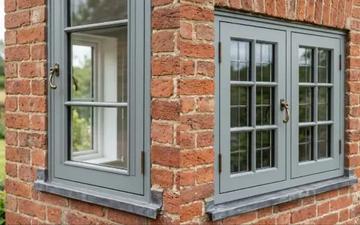
A standard casement swings out. Restrictors can stop it hitting a wall or opening too far over a drop. Egress hinges, where required, let it open wide enough for a person. You need clear space outside: a narrow side path, a fire escape stair, or a window that would hit a downpipe are reasons to stop and think.
Tilt-and-turn first tilts in at the top, which is useful in rain and at night, then turns inward if you release it fully. You need clear space inside: worktops, shelves, blinds and children at the cill. The handle typically has closed, tilt and turn positions. If that is not obvious, people force the gear and the next visit is a repair.
Cleaning, safety and upstairs windows
Tilt-and-turn is genuinely good for upper floors you do not want to clean from a ladder. The turn position brings the outside face into the room. That is a real reason to pay for the hardware. It is a poor reason on a ground-floor window you can walk around, unless the outside is planted or blocked.
Inward opening over a kitchen sink clashes with taps. Inward opening beside a door can block the door. Outward opening over a public footpath may be restricted. Write the clash down on the survey rather than discovering it when the blinds are fitted.
Egress and ventilation
Escape windows in habitable rooms have to provide a clear opening of the size the regulations expect for that situation. Not every bedroom window is an escape window; the layout of the house matters. Where one is required, the hinge and the restrictor must allow it, and the household must be able to open it without a tool. We specify that on the line. We do not assume a tilt position is enough.
Trickle vents are background ventilation, separate from “I can tilt the window”. A tilted window is purge air while you are awake. A vent is the slot that can stay open when the sash is locked. If the job needs vents, both casement and tilt-and-turn frames need a place for them. Part F is not waived because the hinge is fancy.
Weather, seals and price
Outward casements tend to press onto their seals in the wind. Tilt-and-turn relies on its own gear and seals, and it is a proven system when it is a real tilt-and-turn, not a light casement with a slogan. The price gap is the hardware and the sash engineering, multiplied by every opening you convert. Doing the whole house in tilt-and-turn because one upstairs landing needs it is how budgets swell.
Compare quotes on the same openings: which lines are tilt-and-turn, which are casement, which have egress, which have restrictors, which have vents. A single “German windows” total is not comparable with a casement schedule.
What the schedule should name
- Casement or tilt-and-turn, per opening
- Hinge side and handle side, so furniture works
- Egress or restrictor, where needed
- Trickle vents if they are in the specification
- Glass, colour and cill, same as any other window
- Internal clearance noted where the sash turns in
When to book a survey
Book a survey if you are unsure how a window should escape, if paths are tight, or if you want upstairs windows you can clean from the room. We will not put tilt-and-turn on a wall where a blind box and a shelf already own the space. Bring that constraint. The showroom is the right place to feel the handle positions before you commit a whole elevation.
Questions we hear on survey
Are tilt-and-turn warmer?
Not by definition. Warmth is the frame and the glass. The opening mode does not add insulation. A better-specified unit might, and it should be written as glass, not as a hinge.
Can I have tilt-and-turn in a flush frame?
Only if that system is made as a flush tilt-and-turn. Do not assume a Residence-style flush sash and a tilt-and-turn are the same catalogue page. Ask to see it.
Will it leak more?
A properly adjusted tilt-and-turn is a normal window. A sash that is not closed fully, because the handle position was unclear, will leak. The fix is adjustment and a household that knows the handle, not a different material.
Should every window tilt?
No. Use it where inward opening solves a real problem. Leave casement where outward opening is simpler and cheaper and the path allows it.